
Markus’s Watchful Witness
The SonThis thread follows Markus Engseth as a solitary child turns his curiosity about the abandoned yellow house into an increasingly consequential, if incomplete, witness account.
increasing Bearing strength in each event
 decreasing
Bearing strength in each eventdecreasingThe House Across the Street
A Child’s Private World
An abandoned place
Markus Engseth has made the vacant yellow house part of his private world. He knows where its hidden key is and has explored its rooms, inventing stories about the family who once lived there and the death associated with the house.
A stranger arrives
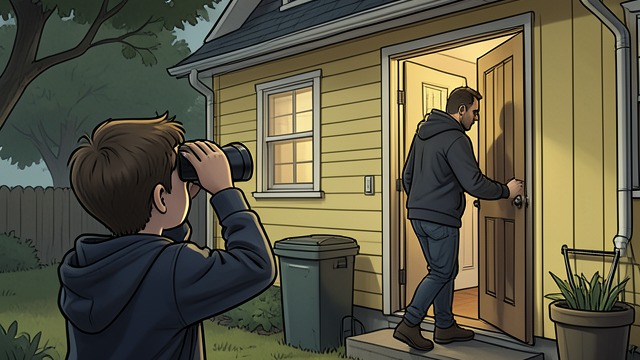
Markus sees a man in a hoodie stop older boys from taking his bicycle. The man enters the house through the basement, and Markus watches from his bedroom with binoculars, fascinated by the apparent return of its missing son.
Curiosity becomes testimony
From his window, Markus sees the visitor inspect the old bedrooms, take a photograph and a red wrestling bag, and leave. The scene is filtered through the boy’s imaginative perspective, but his habit of watching carefully will make him an accidental observer of events the adults have not yet understood.
The Son’s Return
A Neighbourhood Guardian
A boy in danger
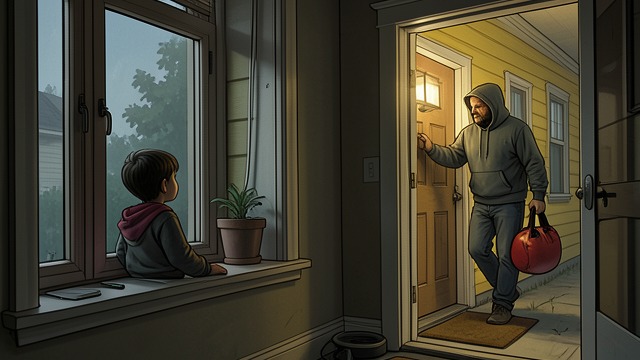
Markus sees two older boys intimidate him over his bicycle. The returning stranger intervenes without making a spectacle of it, retrieves the bicycle, and sends the bullies away with a quiet question about where they live.
An imagined connection
Markus is struck when the stranger answers that he might be Markus’s father. The remark is brief and possibly playful, but it gives Markus a new way to imagine the man: not just as the son from the house, but as someone capable of protecting him.
The watcher’s allegiance
The moment changes the emotional shape of Markus’s surveillance. He still watches the house from a distance, but he is no longer only curious about its mystery. He has begun to feel that the man inside it matters and that he may need help.
Burglars in the Bedroom
A Child Sees the Threat
An arrival after dark
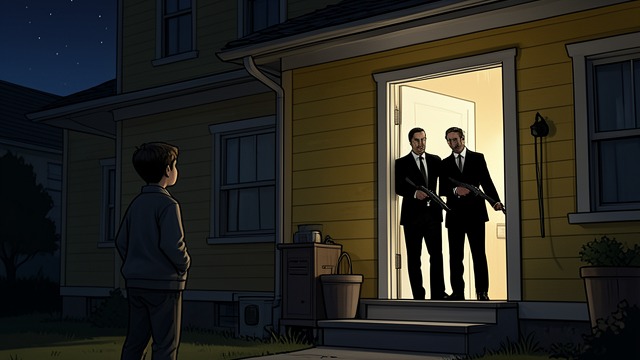
Markus sees two men in black suits enter the yellow house at night. He notices that they carry guns and understand that their presence is not a harmless visit, though he cannot yet know their identities or purpose.
Fear and hesitation
He considers waking his mother or calling the police, but worries that his own fingerprints in the house and the drugs he has seen Sonny hide might create further trouble. His hesitation captures a child’s effort to reason through danger without any reliable adult context.
The intruders’ search
Markus watches the men search the bedrooms while Sonny stays hidden. He cannot locate Sonny, but he continues observing, hoping the man he admires will survive. The episode turns his window into a vantage point on a real criminal pursuit, far beyond the ghost stories he once invented.
A Terrible Shot
The House Falls Silent
A shot from within
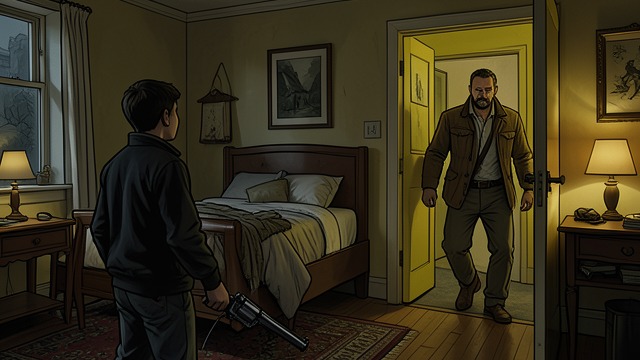
Markus hears a gunshot and waits in fear, unsure whether the wounded person is Sonny or one of the intruders. He sees movement again and is relieved when Sonny emerges from the bedroom alive.
A child’s moral certainty
Markus interprets the shooting as proof that Sonny has defeated bad men. This conclusion is emotionally understandable but incomplete: the child does not see the full moral cost of the violence or know the stories that led the men to the house.
A witness without the whole story
Sonny leaves with the red sports bag, while Markus remains with an image of the house as a place where the brave protect the vulnerable. His point of view helps the novel show how public legend can grow out of fragments, before its subject is understood by those who tell the story.
The Burning House
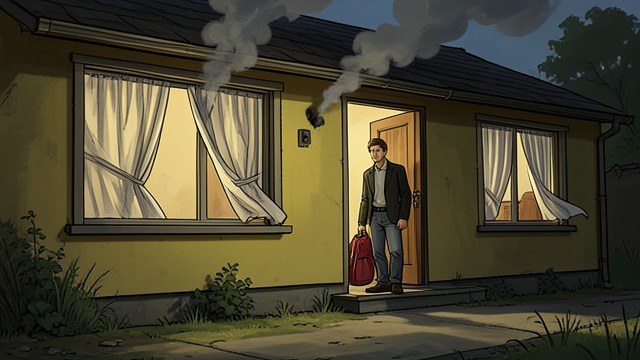
A Witness to Departure
A last encounter
Markus sees Sonny return to the street and speaks with him at the gate. Sonny recalls Markus’s father as a kind man, giving the boy a personal memory to hold against the loneliness of his own home life.
A house left behind
After Sonny walks away, Markus sees curtains billow from the open windows and catches sight of the house burning. The home that held Sonny’s family history, his father’s diary, and the evidence of his return is being consumed as he leaves.
The child’s version of closure
Markus remembers his father’s courage and treats the burning house as part of Sonny’s escape from a haunted past. He cannot know everything that has been lost or chosen, but his perspective gives the departure a small, human witness: a boy who has found a moment of connection and now watches it vanish.
After Sonny escapes, before he is identified as a new resident
Shortly after Sonny begins hiding at Berg’s Yellow House
The night after Sonny hides the stolen drugs at home
Later that night, after one of the armed men remains inside the house
Near the end, after Sonny disappears from Berg’s Yellow House
